Tulsa Saved the Meadow Gold Sign by Taking It Apart |
An enormous dairy advertisement, a little neighborhood rivalry, and the remarkable rescue that gave one of Tulsa's Route 66 landmarks a second life. |
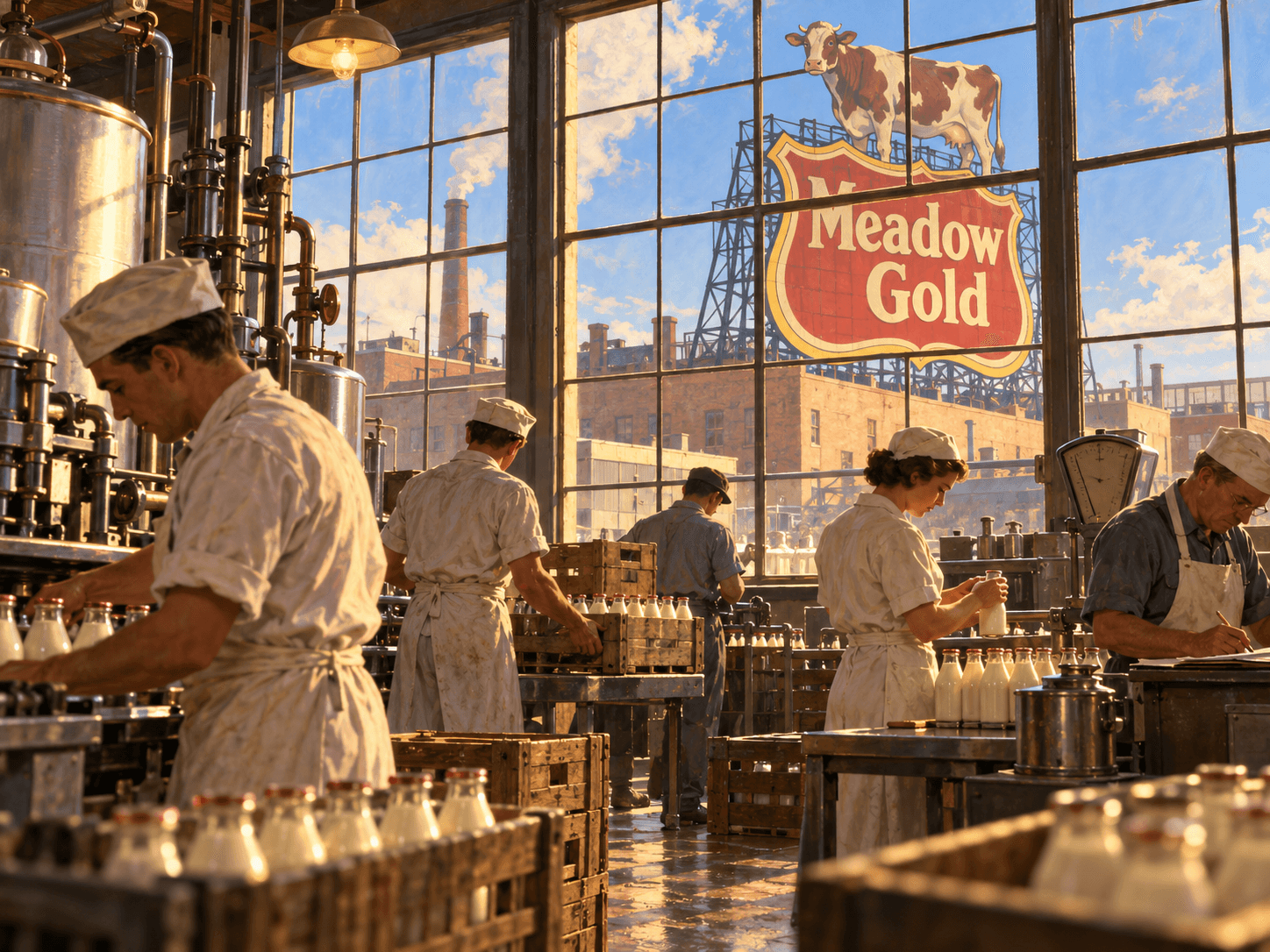 |
There's a wonderful secret hiding in plain sight at the corner of 11th Street and Quaker Avenue. High above a brick pavilion, the enormous yellow letters of the Meadow Gold sign look perfectly at home, commanding their little piece of the Tulsa skyline just as a grand old roadside advertisement should. But those letters have a history that doesn't quite match their address. The building they originally stood upon is long gone, and the sign itself nearly disappeared along with it. In fact, the only reason Meadow Gold is still watching over Route 66 today is that a determined group of people once decided to take the whole thing apart.
To appreciate just how remarkable that is, we have to travel a little farther east along 11th Street, back to 1934, when Tulsa civic leader Early Cass commissioned Claude Neon to create an advertisement for the Beatrice Creamery Company. The result was hardly modest: two massive panels, each measuring 20 by 40 feet, announcing Meadow Gold to anyone who happened to look in their direction. There's even a delightful bit of local legend surrounding its placement. The story goes that the sign was deliberately angled so employees of the rival Hawk Dairy Company couldn't look out their windows without seeing Meadow Gold staring right back at them. Apparently, when it came to selling milk in Tulsa, a little friendly competition could take up an astonishing amount of sky.
For decades, those towering letters were part of the scenery along 11th Street, a familiar reminder of the days when roadside advertisements were built to last and neon was practically an art form. But even giants get old. By the 1970s, Meadow Gold's lights had gone dark, and the years were beginning to show. Then came the news in the early 2000s that the building supporting the sign had been sold and marked for demolition. After nearly seventy years at 11th and Lewis, one of Tulsa's most recognizable roadside landmarks was about to lose the only home it had ever known.
Now, saving an old sign might sound simple enough until you remember the size of this particular sign. We're talking about two enormous panels, each large enough to cover a substantial section of a building. You can't exactly back a pickup underneath something like that, toss it in the bed, and promise to find room in the garage. Yet in 2004, the Meadow Gold sign was carefully dismantled and placed in storage while preservation advocates began the much bigger challenge of bringing it back. For several years, the familiar letters that once towered over 11th Street were out of sight, their future depending on whether enough people could come together to give them another chance.
And here's where this story becomes one of my favorite kinds of Tulsa discoveries: the rescue required an extraordinary combination of history, generosity, and practical problem-solving. The Tulsa Foundation for Architecture and the Oklahoma Route 66 Association helped lead the effort, supported by public funding, private donations, and a National Park Service preservation grant. Markham Ferrell donated land for a new home, and a brick pavilion was designed to support the restored sign. Best of all, Claude Neon—the same company responsible for creating Meadow Gold back in 1934—returned to restore its porcelain letters and rebuild the metal framework. Nearly three-quarters of a century after the original commission, the old signmaker's name was part of the story once again.
On May 22, 2009, the restored Meadow Gold sign was officially dedicated at its new home at 11th and Quaker. The famous yellow letters were back in the Tulsa skyline, looking remarkably comfortable above their new brick pavilion. After years in storage, the landmark had returned to Route 66, just a short distance west of where its story began. There was, however, one charming little detail still missing from the restoration: the clocks. Matching replacements for the long-lost originals wouldn't arrive until 2016. Even a giant sign with clocks, it seems, can take its sweet time getting everything in order.
What I find especially fascinating about Meadow Gold is how much Tulsa history has gathered around something that began as an advertisement for dairy products. The letters take us back to the 1930s, when businesses competed for attention with towering neon displays. Their rescue belongs to another generation entirely, when people saw an aging sign worth saving and figured out how to make that happen. Even the brick pavilion has its own place in the tale, built decades after the original structure and now carrying a piece of the city's past into the future.
And that's the little surprise waiting at 11th and Quaker. Next time you're passing along Route 66, take another look at those enormous yellow letters and the brick pavilion holding them up. The sign has survived darkened lights, a demolished building, years in storage, and a complete change of address. After all that, Meadow Gold is still doing what it was built to do in 1934: catching the attention of people traveling through Tulsa. Only now, there's a much better story behind those two words than anyone could have imagined when they first went up. |
0 Comments
Join the conversation
Be the first to comment
Share your thoughts above.