
There's Something Unusual About the Drones Being Built in Tulsa. |
The most interesting part isn't necessarily how they fly. It's the question OSU-Tulsa researchers ask before they ever start building. |
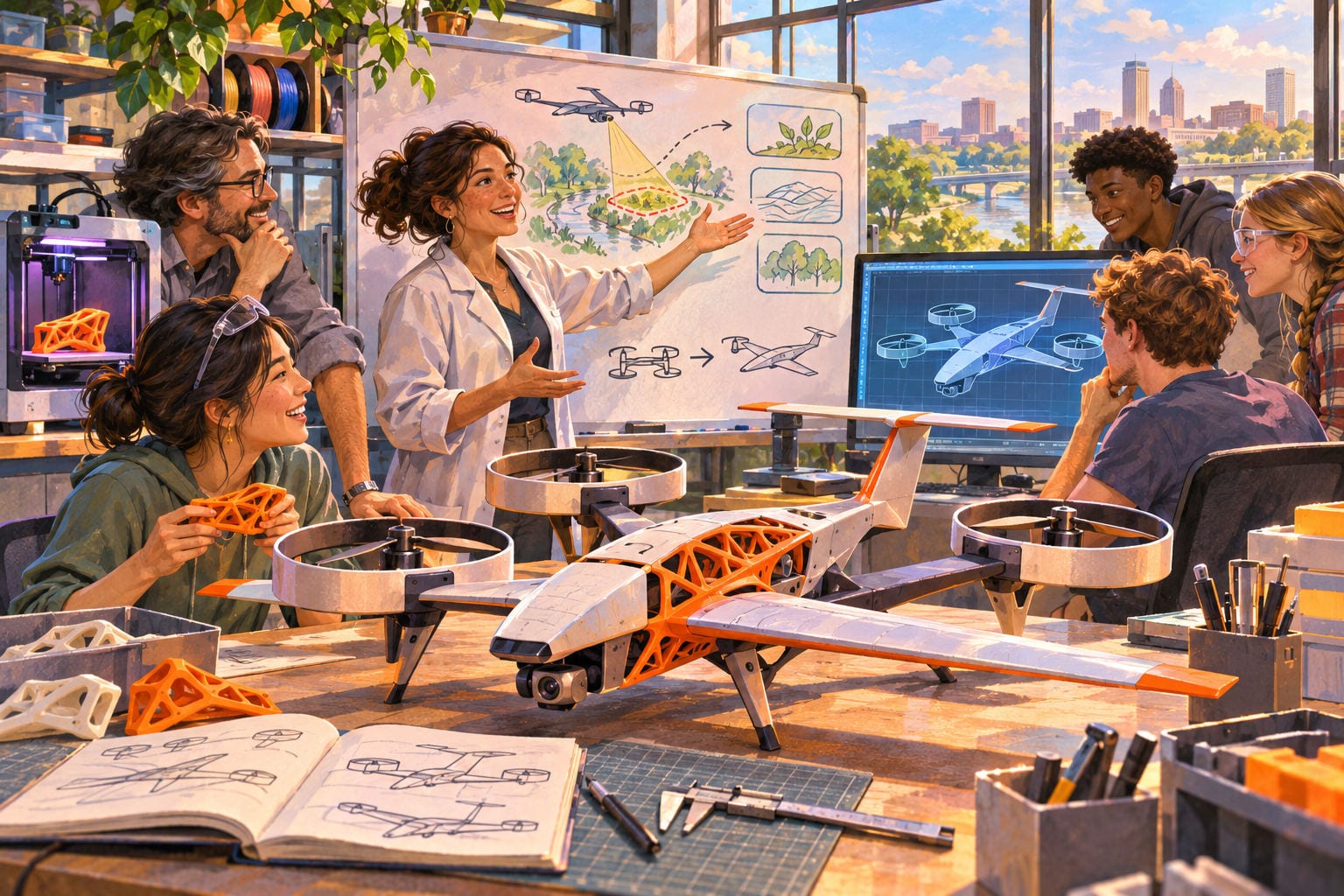
What would a firefighter ask for if a drone could be designed around the job instead of picked from a shelf? A better view of a dangerous scene? Maybe a way to carry a hose or help move water toward a fire? Those are among the possibilities Anthony Comer has raised while talking about the future of unmanned aircraft. They aren't reports of drones already fighting fires for Tulsa crews. They're clues to the unusual approach taking shape at OSU-Tulsa: the first question isn't what the drone can do. It's what someone needs done.
Think of the drones we're used to seeing. A finished aircraft comes with its own size, cameras, motors and limits, and the person using it figures out which jobs fit. Comer's idea turns that around. If a particular task demands something different, why should the aircraft have to look or work exactly like the next one? A firefighter's wish list and a farmer's needs, for example, might point designers in different directions. The machine would follow the mission—not the other way around.
This isn't happening in some faraway technology hub. Comer directs the Simulation to Flight Applied Research Laboratory, or S2FAR, at OSU-Tulsa's Helmerich Research Center. In an October 29 university profile, he described helping organizations explore purpose-built aircraft and find ways to demonstrate new ideas without having to develop every part alone. For someone with a useful problem but no aircraft-design team, the lab's aim is to make the distance between the question and a testable idea less daunting.
And there is already something tangible behind the research. S2FAR's completed-projects portfolio includes Rapid Development of a Low-Cost Multi-Purpose Response Drone. On the lab's S2F-X200 page, the aircraft is described as being built largely from 3D-printed parts. It has propellers meant to lift it vertically and others meant to move it forward. That arrangement sounds simple until you consider what the aircraft must manage: getting off the ground is one task; moving smoothly into forward flight is another. This is a real research project, not the hypothetical fire-hose aircraft from Comer's examples.
Before a design like that flies, much of the challenge can be explored without leaving the computer. S2FAR describes using a digital twin, a computer model that lets researchers examine the aircraft and its controls. The S2F-X200 page also features videos labeled as strong-wind testing and transition flights. There is something pleasingly unexpected about it: behind a flying machine that might look futuristic is a long sequence of very practical questions about balance, control and what happens when one kind of flight becomes another.
The people doing that work are another part of the Tulsa Story. S2FAR's team roster includes professional staff, graduate researchers and undergraduates. Its project collection ranges across flight testing and unconventional aircraft designs. These are not just diagrams dreamed up for an exciting future. The lab documents actual design and testing work, with researchers learning what their ideas can—and cannot yet—do.
Comer also sees an opportunity for businesses and organizations that have a specialized need but cannot easily develop their own aircraft. The university describes S2FAR as helping such partners get closer to demonstrations. That's an ambition worth watching, not proof that a custom drone is already saving a particular customer money or performing a dangerous mission in the field. The published material doesn't establish those outcomes, and a completed research project isn't the same thing as a ready-to-buy product.
Still, that's what makes this little corner of Tulsa so interesting. Instead of promising a flying gadget that will do everything, these researchers are exploring what happens when they get specific. A task becomes a design problem. A design becomes a model. A model becomes something people can build and test. The possibilities are exciting precisely because the hard work is happening in the open, one engineering question at a time.
So the next time you spot a drone overhead, you might wonder less about how high it can climb and more about the need that shaped it. Somewhere along the road from a question to a flying machine, people at OSU-Tulsa's S2FAR lab are working on the part you can't see from the ground: deciding what the aircraft is for. |
0 Comments
Join the conversation
Be the first to comment
Share your thoughts above.