
At This Tulsa Theater, Booing the Villain Is Only the Beginning |
What began as a production planned for just a few performances in 1953 is approaching its 73rd anniversary—with an unusual part for the audience to play. |
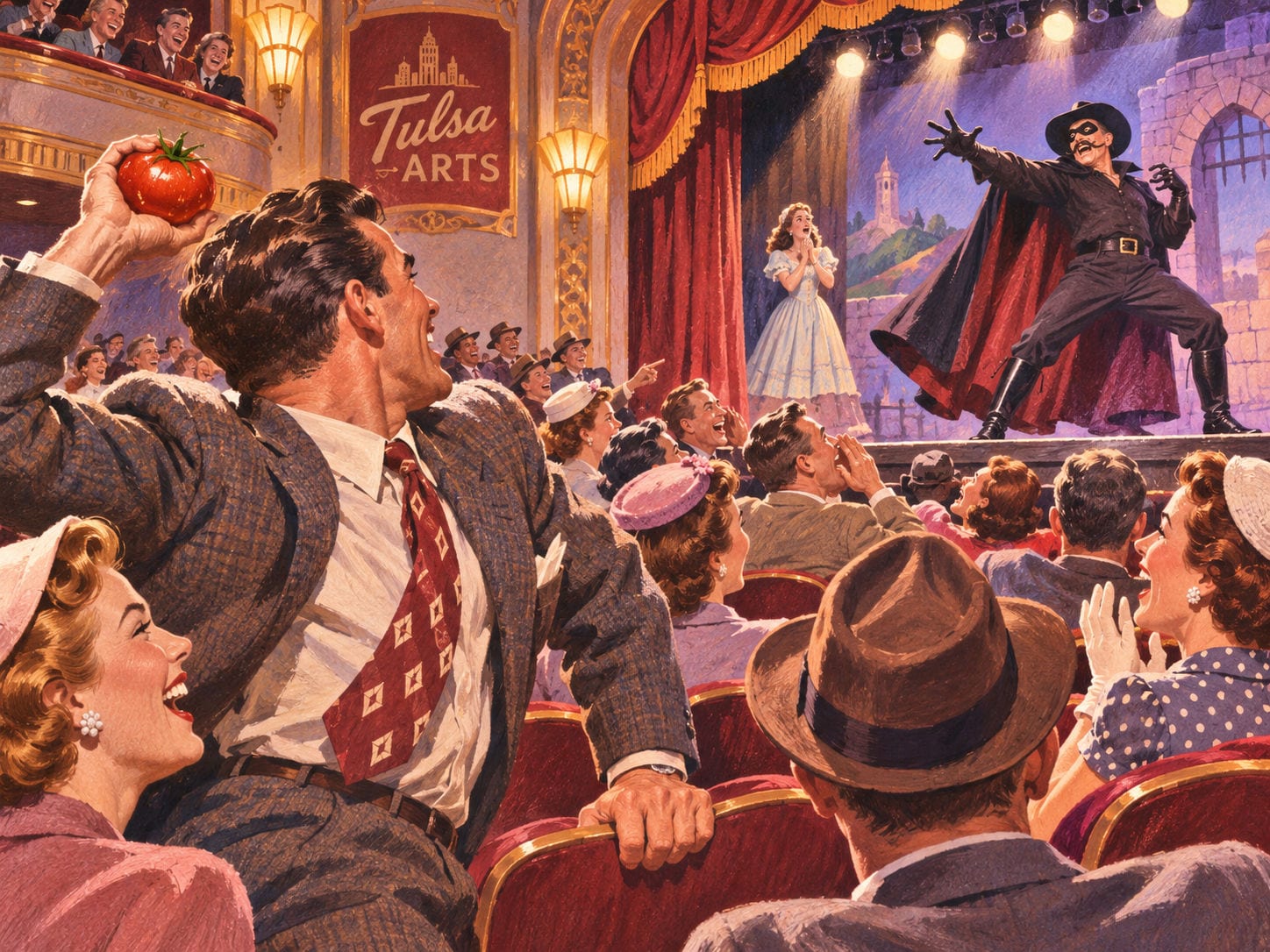
At most theaters, throwing a tomato at the villain would be a good way to end your evening early. At Tulsa Spotlight Theater, tomatoes are part of the invitation. The old-fashioned melodrama The Drunkard encourages people to boo and hiss at its villain, cheer for its hero and, according to the theater, toss tomatoes supplied during the show. The audience is allowed to answer back.
And the evening has more than one act. The doors open before a singalong and the Olio, a variety-show segment featuring performers such as singers, musicians, dancers, magicians or comedians. Then the melodrama takes over, complete with the sort of larger-than-life characters who make cheering and booing feel perfectly appropriate. The theater advertises this as a participatory night out, not a production that expects everyone to sit silently until the curtain falls.
It would be easy to mistake that playful approach for a recently invented gimmick. The story goes back to November 14, 1953, when actor and speech teacher Richard Mansfield Dickinson staged his adaptation of the nineteenth-century melodrama Ten Nights in a Barroom. According to the theater's own history, Dickinson and his fellow performers expected to put on only a few shows. Instead, they drew enough interest to keep returning to the stage.
There is an appealing reversal in that history. A work originally associated with temperance and serious moral warnings has become a comedy that invites its audience to join in. The script's melodramatic villains and heroes remain part of the attraction, but the ritual surrounding them—songs, variety acts and enthusiastic audience participation—has become a Tulsa tradition of its own. Oklahoma's official tourism guide describes the show as a comic version of the old morality play.
The building has an earlier, equally surprising chapter. Long before tomatoes became part of the theater's identity, Bruce Goff designed the Riverside Studio in 1928 for his former piano teacher, Patti Adams Shriner. It was intended as a residence and piano recital hall. Dickinson bought the property in 1941, and the music studio eventually became the home of a production that could hardly be accused of keeping quiet. The Society of Architectural Historians documents the studio's architectural history and its later theatrical life.
From Riverside Drive, one of the first clues is the building's striking circular window. It belonged to a residence and recital hall before Dickinson made the place home to spirited melodrama. Today, the same address holds two Tulsa curiosities at once: an inventive piece of architecture and a performance whose audience is welcome to make a little noise.
The long-running tradition has not been literally uninterrupted. Performances paused during the COVID-19 pandemic, and KJRH reported their return in May 2021. That interruption is worth acknowledging even as the theater celebrates the extraordinary span from its first performance in 1953 to the anniversary planned for 2026.
On Saturday, November 14, 2026, Tulsa Spotlight Theater is planning a 73rd-anniversary performance at 1381 Riverside Drive. The organizer lists doors opening at 7:00 p.m. and the program running 7:15–10:00 p.m. CST. Readers interested in the show can check the official anniversary listing for current details and ticket options; availability is not guaranteed by the listing alone.
A recital hall, a play meant to run a few nights, and a villain who still has to contend with the people in the seats: Tulsa has managed to keep all three connected for 73 years. At the Spotlight, the audience has more to do than watch. It has a role to play—and sometimes a tomato to throw. |
0 Comments
Join the conversation
Be the first to comment
Share your thoughts above.